
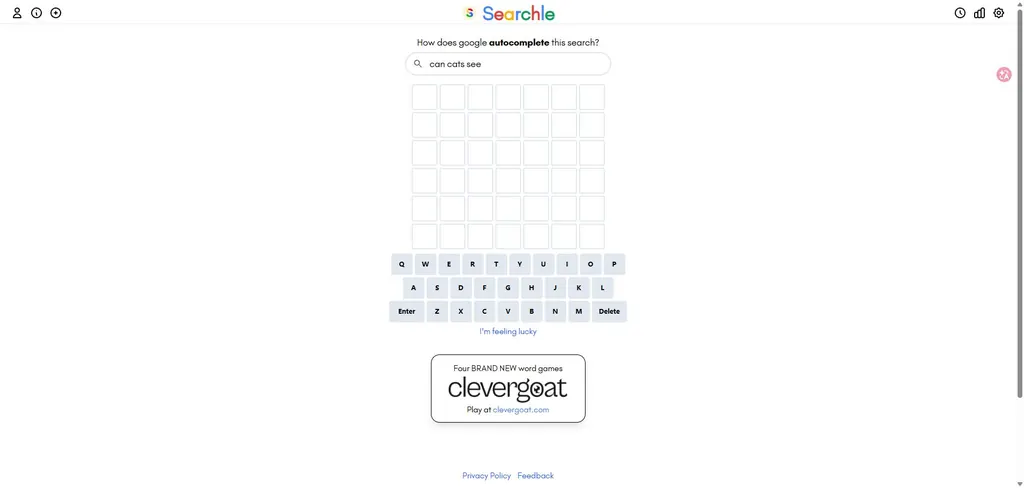














What Is Searchle?
Searchle (searchle.net) is a daily browser guessing game where you try to predict what people actually type into Google Search autocomplete. Each round gives you the beginning of a real search query, and you have to guess the most common completions.
While it belongs to the same family of quick daily browser mind games as Krillion, Searchle flips the psychology: instead of hunting for the rarest answer nobody else thought of, you are trying to read the collective mind of everyday internet users.
How to Play Searchle
Controls on Desktop and Mobile
- Desktop: Type your predicted search completion into the input bar and press Enter to check if it ranks among the top autocomplete results.
- Mobile and Tablet: Tap the search box, enter a common phrase, and submit. Use Fullscreen below the player for extra screen space.
Round Rules
- Daily Autocomplete Prompts: Each day presents a fresh set of partial search queries.
- Guess Top Completions: You have a limited number of guesses to uncover the top real search phrases.
- Instant Feedback: Matches light up immediately based on how high they rank.
Scoring and How to Win
You win a Searchle round by uncovering the top real Google autocomplete phrases before running out of guesses. Thinking like the average searcher—common questions, everyday problems, and pop-culture queries—is the key to solving each prompt cleanly.
How Searchle Differs From Krillion
- Common Crowd Answers vs. Rare Answers: Krillion rewards the rarest valid answer; Searchle rewards guessing the most popular real search phrases.
- Adjacent Daily Mind Game: Searchle is great as a palette cleanser after Krillion when you still want a daily crowd-psychology challenge.
Strategy Tips for Searchle
- Think of everyday phrasing: Real searchers type simple, literal phrases like "how to...", "near me", or "why does...".
- Avoid overly formal wording: People rarely type academic terms into search bars—keep guesses conversational.
- Start with broad verbs or nouns: High-frequency words narrow down the remaining slots quickly.
How Google Autocomplete Ranks Queries and Patterns to Spot
Switching from rare-answer trivia to Searchle means training yourself to recognize how millions of everyday searchers phrase urgent questions, curiosity prompts, and household fixes:
- Focus on practical intent buckets: Most top autocomplete endings fall into predictable groups—health symptoms, pet behavior, celebrity facts, cooking shortcuts, software glitches, or local travel needs. When a partial stem starts with "Can dogs eat..." or "Why do cats...", common kitchen ingredients and everyday household habits almost always occupy the top slots.
- Match natural spoken grammar over polished writing: Search users rarely type full textbook sentences. Instead, they enter blunt two- to four-word fragments such as "so tired", "hurt", "cost", "worth it", or "illegal". Testing short core nouns or adjectives quickly reveals which topic cluster the autocomplete list leans toward.
- Use misses to rule out whole categories: Every rejected guess gives you valuable elimination feedback—if a food-related completion misses on an open stem, pivot immediately toward weather, home repair, or entertainment rather than guessing five similar foods in a row.
Common Mistakes That Waste Your Guesses
- Thinking like a Krillion player: Trying to be clever, witty, or obscure works against you in Searchle. Always ask what the blandest, most mainstream internet user would type at midnight.
- Guessing hyper-specific brand names too early: Broad generic nouns (milk, coffee, water, battery, car) appear in real search logs far more often than niche products.
Reading Clues From Stems Like "Is It Normal to..." or "How Much Does..."
Different starting stems point strongly toward distinct everyday concerns:
- Time, Cost, and Symptom Stems: Prompts opening with "How long does...", "How much is...", or "Why is my..." almost always favor daily chores, common appliances, body aches, or pet questions over abstract trivia.
- Pop Culture and Comparison Stems: Stems mentioning "vs", "worth watching", or "still together" point toward mainstream streaming hits, smartphones, or household habits rather than obscure niche titles—keeping every guess anchored in broad, high-volume everyday queries.
Searchle FAQ
When does Searchle reset?
Searchle updates with new daily search prompts every 24 hours.
Is Searchle free to play?
Yes, it runs free in your browser with no account required.
Does Searchle work on mobile?
Yes, it is fully playable on mobile browsers.
Does Searchle use rare-answer scoring like Krillion?
No—unlike Krillion, Searchle asks you to guess the most common real search queries rather than the rarest ones.
More games like Krillion
- Noillirk — Mirrors Searchle's crowd-guessing instinct in Crowd mode, plus lets you flip to Rare mode like Krillion.
- Wonderhop — Pairs a crowd-favorite Sky round with Krillion-style Abyss rare answers plus Past and Future trivia.
- STRANDED — Flips the goal from popular queries to obscure rare answers across 6 daily prompts and 9 escape endings.
- PlayDaily Krillion — Offers unlimited 7-prompt rare-answer dives whenever you finish your daily Searchle puzzle.
- Browse all Krillion alternatives to compare rules, timers, and modes across every playable game in the hub.
No comments yet. Drop your rarest answer or score below!