











What Is Uncommon Trivia?
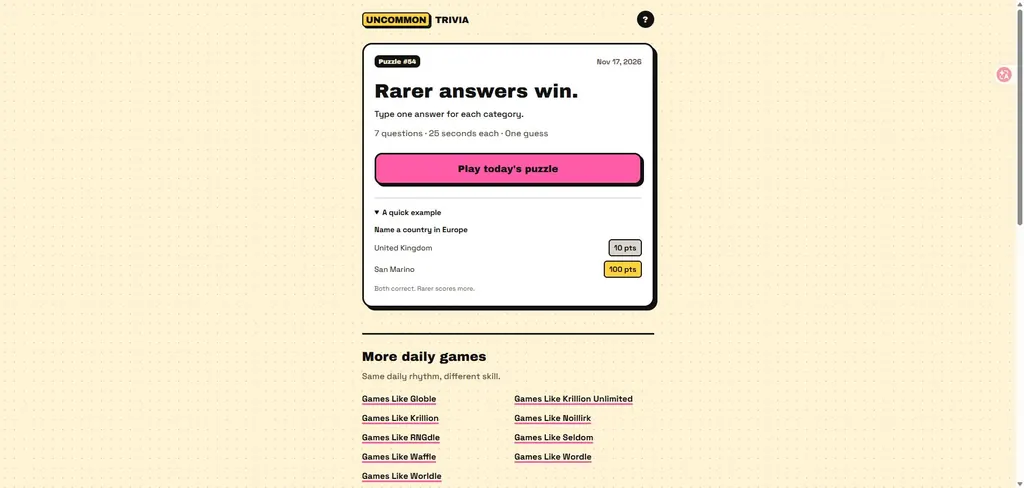
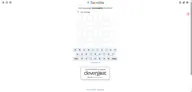
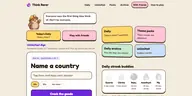
Uncommon Trivia (uncommontrivia.com) is a daily browser trivia game where answer rarity is measured objectively using real Wikipedia pageview traffic. Each day brings 7 open-ended questions, and your score depends on picking a valid entity whose Wikipedia article receives fewer pageviews—meaning deep niche knowledge is rewarded directly by hard traffic data rather than just today's player pool.
How to Play Uncommon Trivia
Controls on Desktop and Mobile
- Desktop: Click the answer input, type your valid entity name, and submit your single guess for each question.
- Mobile and Tablet: Tap the input box and type using your mobile keyboard. Tap Fullscreen below the player for a wider view.
Round Rules
- 7 Daily Questions: Every player receives the same 7 prompts each day.
- One Guess per Question: Make sure your answer strictly fits the prompt criteria.
- Objective Traffic Scoring: Valid answers are matched against Wikipedia articles and scored by pageview obscurity.
Scoring and How to Win
In Uncommon Trivia, household names (like Albert Einstein or Eiffel Tower) have millions of Wikipedia views and earn low scores. Picking an accurate but rarely visited historical figure, obscure species, or minor landmark earns dramatically more points.
How Uncommon Trivia Differs From Krillion
- Wikipedia Pageviews vs. Player-Pool Percentage: Krillion scores rarity based on what other Krillion players typed today; Uncommon Trivia scores rarity using Wikipedia traffic.
- No 25-Second Rush: Uncommon Trivia focuses on thoughtful, accurate recall rather than a 25-second typing sprint.
Strategy Tips for Uncommon Trivia
- Think of secondary historical or regional figures: Avoid headline names and pick valid subjects that only enthusiasts look up on Wikipedia.
- Verify exact eligibility: Because you only get one guess per question, make sure your answer unmistakably satisfies every constraint in the prompt.
- Use specific full names: Clear, unambiguous entity names match cleanly.
How Wikipedia Pageview Rarity Works Behind the Scenes
Because Uncommon Trivia ranks valid answers by real-world encyclopedia readership rather than live player polls, scoring high requires a very different instinct from timed trivia sprints:
- Pop Culture Spikes Hurt Rarity: Even a niche historical person, minor planet, or obscure species can rack up huge Wikipedia traffic if it recently appeared in a viral video, news headline, or movie adaptation. Classic, un-trending academic subjects—like 18th-century regional treaties, minor mountain peaks, or lesser-known botanical genera—tend to have consistently quiet pageview counts all year long.
- Depth Within One Domain Beats Trivia Quirks: In player-poll games, quirky words like kumquat still trip people up. In Uncommon Trivia, a well-known "weird" topic still attracts thousands of monthly Wikipedia readers. Instead, dig into specific geographic subdivisions, secondary sports leagues, or specialized scientific names that genuinely receive low daily traffic.
- Take Advantage of Having No 25-Second Timer: Since you are not racing a countdown, pause before submitting to double-check both factual accuracy and exact canonical naming.
Common Mistakes That Cost Points
- Picking a redirect or ambiguous nickname: Since answers map to Wikipedia articles, informal abbreviations or shared surnames risk matching the wrong entry or missing validation altogether. Always enter the full, unambiguous name.
- Overlooking strict date or geography qualifiers: With only one guess per question, missing a small detail like "south of the equator" or "born before 1900" turns a high-rarity idea into zero points.
Category-Specific Ways to Find Quiet Encyclopedia Entries
Applying one simple traffic filter before submitting helps avoid high-pageview surprises across recurring question types:
- Geography & Nature: Major rivers, national capitals, and iconic predators stay heavily searched by students daily. Tributaries, regional lakes, municipal districts, or subspecies names usually draw dramatically fewer encyclopedia visits.
- History, Science & Culture: Supporting architects, regional composers, minor astronomical moons, and specific historical treaties provide far steadier obscurity than Nobel laureates or blockbuster directors—helping you build consistent high scores across all seven daily questions.
- Checking Regional Variants: When a broad prompt covers inventions, dishes, or landmarks across multiple continents, skipping North American and Western European examples almost always reduces baseline Wikipedia traffic right away without sacrificing factual accuracy.
Uncommon Trivia FAQ
When does Uncommon Trivia reset?
A fresh set of 7 daily questions appears once every 24 hours.
How does Uncommon Trivia measure rarity?
It uses real Wikipedia pageview statistics—fewer pageviews for a valid answer means a higher rarity score.
Is it free to play?
Yes, completely free in your browser with no account required.
Can I play on my phone?
Yes, it runs smoothly on mobile browsers.
More games like Krillion
- Cosmillion — Scores rarity against today's live player pool under a 25-second clock instead of untimed Wikipedia pageview traffic.
- STRANDED — Adds a 25-second speed timer and 9 unlockable alien-escape endings across 6 daily prompts.
- Anything Grid — Puts untimed obscurity into a 3×3 matrix where each answer must match two intersecting trivia categories.
- Krillion Game — Replaces Uncommon Trivia's deliberate lookup pace with a timed 7,000-meter rare-answer sprint.
- Browse all Krillion alternatives to compare rules, timers, and modes across every playable game in the hub.
No comments yet. Drop your rarest answer or score below!